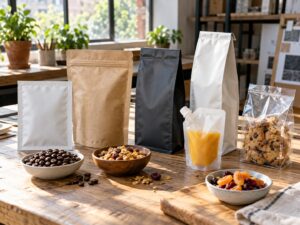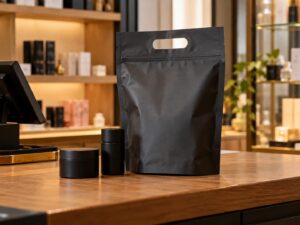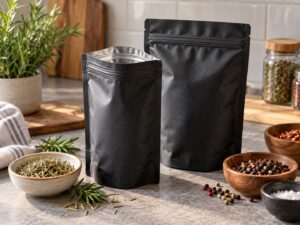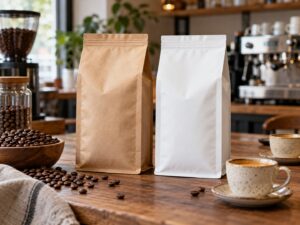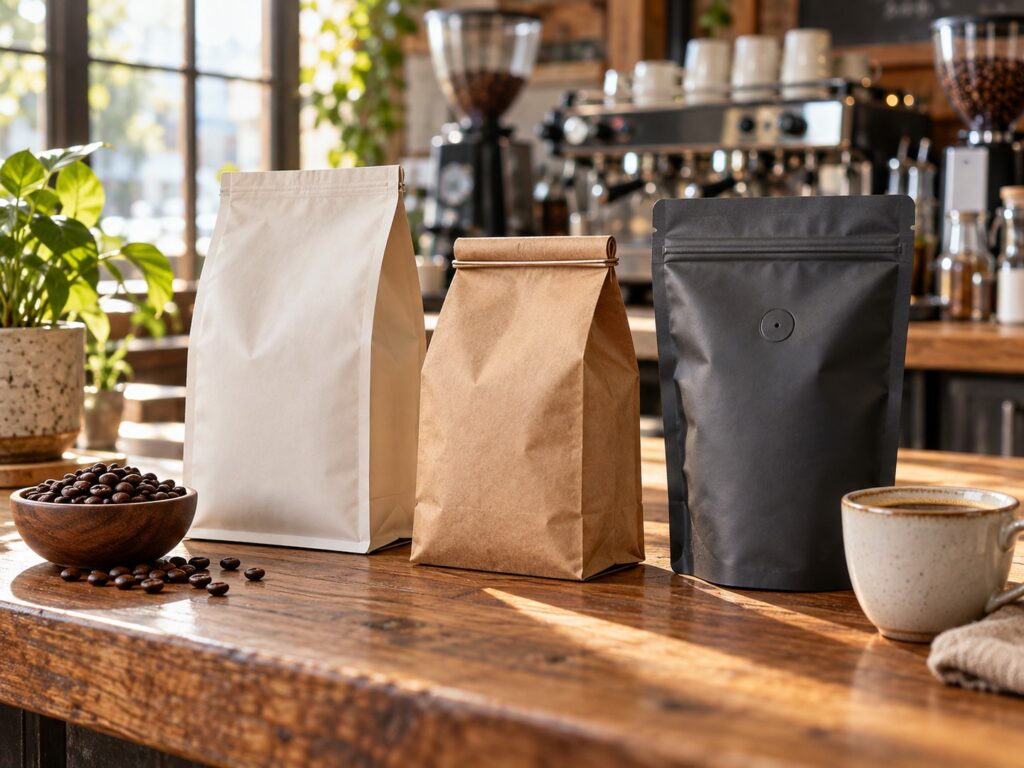
Coffee packaging protects roasted beans from oxygen, light, and moisture — the three things that destroy fresh-roasted flavor within days. The right coffee packaging bag combines a high-barrier laminate, a one-way degassing valve, and a resealable closure, in a format (stand-up pouch, flat bottom bag, or side gusset bag) matched to your brand’s shelf presence and filling line. This guide breaks down every option so roasters, coffee brands, and wholesalers can specify bags confidently — and get factory-direct pricing.
Table of Contents
– 5 Main Types of Coffee Packaging Bags
– Coffee Bag Materials: How Barrier Layers Work
– Degassing Valves and Tin-Ties Explained
– Comparison Table: Which Coffee Bag Fits Your Brand?
– Custom Printing: Digital vs. Gravure
– How Coffee Bags Are Manufactured
– How to Choose a Coffee Bag Manufacturer
– FAQ
5 Main Types of Coffee Packaging Bags
Stand-up pouches, flat bottom bags, side gusset bags, tin-tie bags, and pillow bags cover more than 95% of the retail coffee market. Each format holds coffee equally well — the differences are shelf presentation, filling equipment, and cost per unit.
1. Stand-Up Coffee Pouches
A stand-up pouch (doypack) has a bottom gusset that lets the empty or filled bag stand upright on a shelf. It is the most versatile format: it works with or without a zipper, takes a degassing valve and tin-tie easily, and costs less per unit than flat bottom bags at the same volume. Standard sizes run from 4 oz (113 g) to 5 lb, with 12 oz and 250 g being the two highest-volume sizes we export.
Best for: specialty roasters, subscription coffee brands, private label, sampling sizes.
2. Flat Bottom Coffee Bags (Box Bottom)
A flat bottom bag (also called box bottom or block bottom) has a rectangular base, so it stands square on the shelf and presents a large front, back, and base panel for branding. It holds its shape better than a stand-up pouch when partially filled, which is why premium roasters and third-wave coffee brands favor it. The trade-off: roughly 10–20% higher unit cost and slightly more complex filling.
Best for: premium and specialty retail coffee, gift coffee, brands competing on shelf design.
3. Side Gusset Coffee Bags
The classic format used by most commercial roasted-coffee brands (think 1 lb and 12 oz grocery bags). Side gussets fold inward so the bag expands as it fills, and the top is folded and taped or sealed after filling. Side gusset bags maximize the vertical panel for artwork and ship flat, keeping freight costs down.
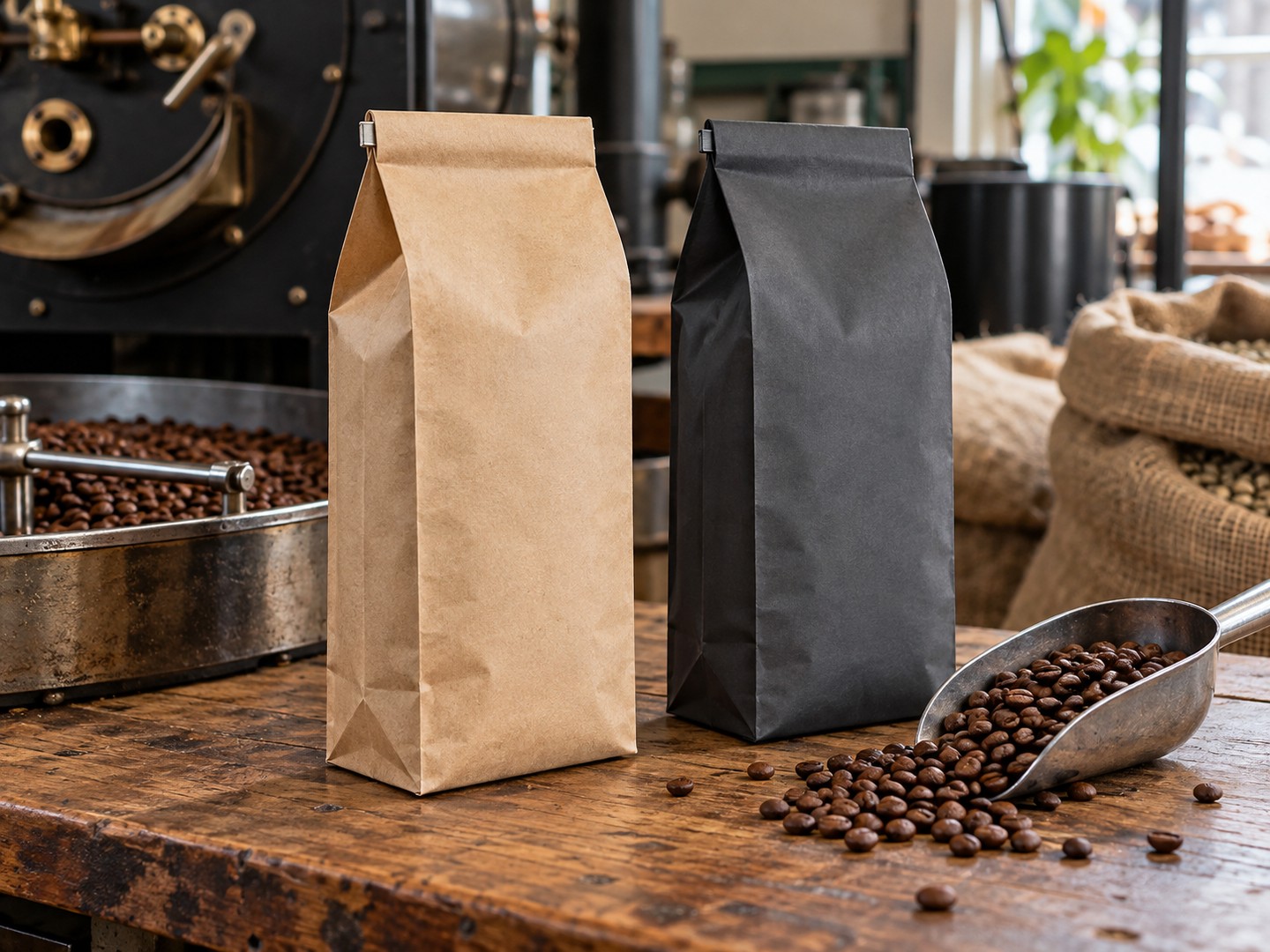
Best for: wholesale coffee, grocery distribution, 12 oz–2 lb retail sizes.
4. Tin-Tie Coffee Bags
A tin-tie is a flat metal strip laminated inside the top fold, letting customers bend and re-close the bag by hand. Tin-ties are usually combined with a valve in kraft paper or laminated structures for café counter sales where customers scoop beans directly.
Best for: cafés, coffee shops selling beans over the counter, zero-waste refill stations.
5. Pillow Bags (Vertical Form-Fill-Seal)
Pillow bags are made on an HFFS/VFFS line from roll stock film, filled and sealed in one automated pass. They are the lowest-cost format per unit and dominate the instant coffee and single-serve segment. We supply both finished pillow bags and custom printed coffee rollstock film for brands running their own filling lines.
Best for: instant coffee, single-serve sticks, high-volume automated lines.
Coffee Bag Materials: How Barrier Layers Work
Every quality coffee bag is a multilayer laminate — typically three layers, each doing one job. Roasted coffee releases CO₂ for days after roasting and absorbs oxygen and moisture continuously, so the film structure decides shelf life more than anything else.
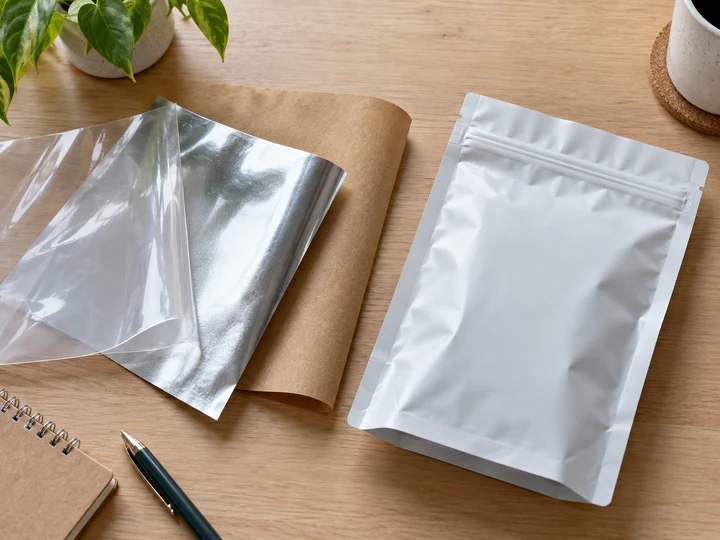
| Layer | Common Materials | Function |
|---|---|---|
| Outer | PET, matte OPP, kraft paper | Print surface, scuff resistance, brand look |
| Middle | AL (aluminum foil) or VMPET (metallized PET) | Oxygen + light barrier — the “engine” of shelf life |
| Inner | PE or CPP | Heat-seal layer, food-contact safe, puncture resistance |
Structure rules of thumb:
- PET/AL/PE — the maximum-barrier structure. Blocks essentially all oxygen and light; roasted coffee stays fresh 12+ months. Choose it for whole bean coffee shipped long distances or stored long term.
- PET/VMPET/PE — metallized alternative at a lower cost, about 90–95% of foil’s barrier performance. The workhorse for most retail coffee.
- Kraft paper / PET / VMPET / PE — paper look outside, full laminate protection inside. The natural, artisanal appearance buyers associate with specialty coffee, without sacrificing shelf life.
- Recyclable mono-material (PE/PE or PP/PP) — mono-polyolefin structures for brands with sustainability commitments; compatible with store drop-off programs. See our guide on recyclable spout pouches for how mono-material design works.
Shelf-life benchmark: a 250 g bag in PET/AL/PE with a valve typically holds commercial freshness for 9–12 months; a clear-window metallized bag holds 6–9 months.
Degassing Valves and Tin-Ties Explained
A one-way degassing valve lets CO₂ escape without letting oxygen in. Freshly roasted coffee emits CO₂ for roughly 3–14 days after roasting. Seal it in a non-valved bag and the bag balloons or bursts; open it to vent and oxygen stales the beans. The valve solves both: it vents CO₂ pressure while blocking air from re-entering.
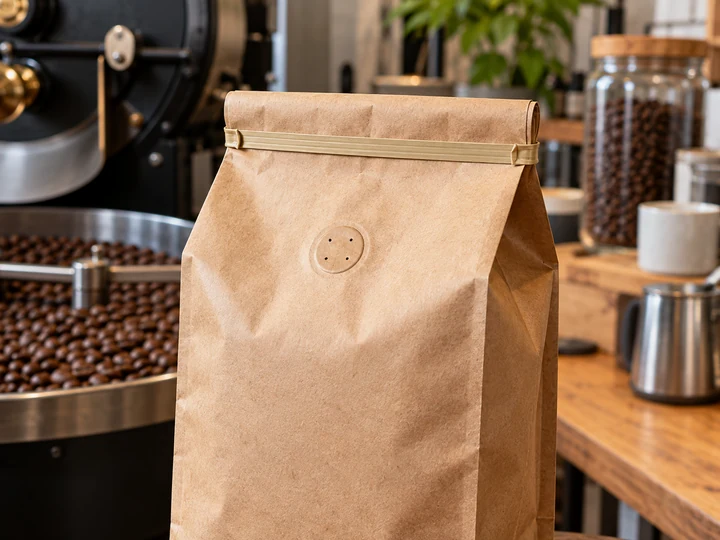
Two standards matter to buyers:
- Valve placement: center-back mounted valves are the industry default; some roasters prefer bottom gusset mounting for display reasons.
- Squeeze-test valves: premium valves click audibly when pressed, a freshness cue retailers use in demos.
Tin-ties pair naturally with valves in café formats: the valve handles storage, the tin-tie handles repeated customer access.
Comparison Table: Which Coffee Bag Fits Your Brand?
| Format | Barrier Options | Valve + Zipper | Typical MOQ* | Relative Cost | Best Seller Size |
|---|---|---|---|---|---|
| Stand-up pouch | VMPET / foil / kraft laminate | ✅ / ✅ | 10,000 pcs | $ | 12 oz, 250 g |
| Flat bottom bag | VMPET / foil / kraft laminate | ✅ / ✅ | 10,000 pcs | $$ | 12 oz, 340 g |
| Side gusset bag | VMPET / foil | Valve ✅ / zipper rare | 10,000 pcs | $ | 1 lb, 500 g |
| Tin-tie kraft bag | Kraft + laminate liner | Valve ✅ / tin-tie | 10,000 pcs | $$ | 250 g, 500 g |
| Pillow bag (rollstock) | Full range incl. foil | n/a | 100 kg film | $ | any VFFS size |
*Our factory MOQ for custom printed coffee bags is 5,000 pieces per design; digital printing runs can start lower. Samples are free of charge — you only cover shipping.
Custom Printing: Digital vs. Gravure
Gravure printing delivers the lowest unit cost and sharpest color at volume; digital printing wins for short runs and fast turnaround.
| Gravure (rotogravure) | Digital | |
|---|---|---|
| Up to 9 colors + spot colors | ✅ | ✅ (CMYK + white) |
| Cylinder cost | Yes (one-time per design) | None |
| Best quantity | 10,000+ pcs | 500–10,000 pcs |
| Lead time | 12–18 days | 5–10 days |
| Color consistency across reorders | Excellent | Good |
All food-contact inks are compliant with FDA and EU 10/2011 requirements. Matte, glossy, spot-UV, and hot-stamp finishes are available on both routes.
How Coffee Bags Are Manufactured
- Film printing — artwork is gravure- or digitally printed on the outer film, then laminated to the barrier and seal layers.
- Lamination & curing — adhesive lamination bonds layers; 24–48 hours curing locks bond strength.
- Slitting — laminated rolls are slit to bag width.
- Pouch converting — bags are formed, valve and zipper inserted, bottom gusset sealed, and bags cut. Each bag passes an inline seal-strength check.
- Quality testing — completed batches are tested for seal strength, drop resistance, and barrier integrity (vacuum/water-bath leak test) before packing.
A typical custom order timeline: artwork confirmation → cylinder making (5–7 days) → printing & converting (7–10 days) → shipping.
How to Choose a Coffee Bag Manufacturer
Ask these five questions before placing a first order — they separate trading companies from real factories and prevent the three most common import failures (wrong barrier, color drift, delayed shipments):
- Can you provide the laminate structure in writing? A real factory specifies layer materials and micron thickness per layer, not just “high quality.”
- What is your valve brand and failure rate? Cheap valves leak oxygen silently. We use food-grade one-way valves with a tested failure rate below 0.1%.
- Do you print in-house? In-house gravure printing means color control across reorders; outsourced printing means drift.
- What certifications cover the food-contact layer? FDA, EU 10/2011, and ISO 9001 at minimum; BRC certification for larger retailers.
- Can I get pre-production samples of MY artwork? Never approve a design from a PDF mockup alone.
Our full supplier-vetting checklist — including red flags and reference questions — is in How to Find a Reliable Coffee Bags Wholesale Supplier.
FAQ: Coffee Packaging
What is the best packaging for coffee beans?
A stand-up or flat bottom pouch in PET/AL/PE or PET/VMPET/PE with a one-way degassing valve and resealable zipper is the best packaging for roasted whole-bean coffee. The foil or metallized barrier blocks oxygen and light, the valve vents CO₂ without letting air in, and the zipper supports repeated opening. This combination keeps coffee commercially fresh for 9–12 months.
How long does coffee stay fresh in a bag with a valve?
Roasted coffee in a foil-laminate bag with a one-way valve stays fresh 9–12 months unopened, and 2–4 weeks after opening. Without a valve or high barrier, that window drops to 1–3 months unopened because CO₂ buildup and oxygen ingress degrade flavor.
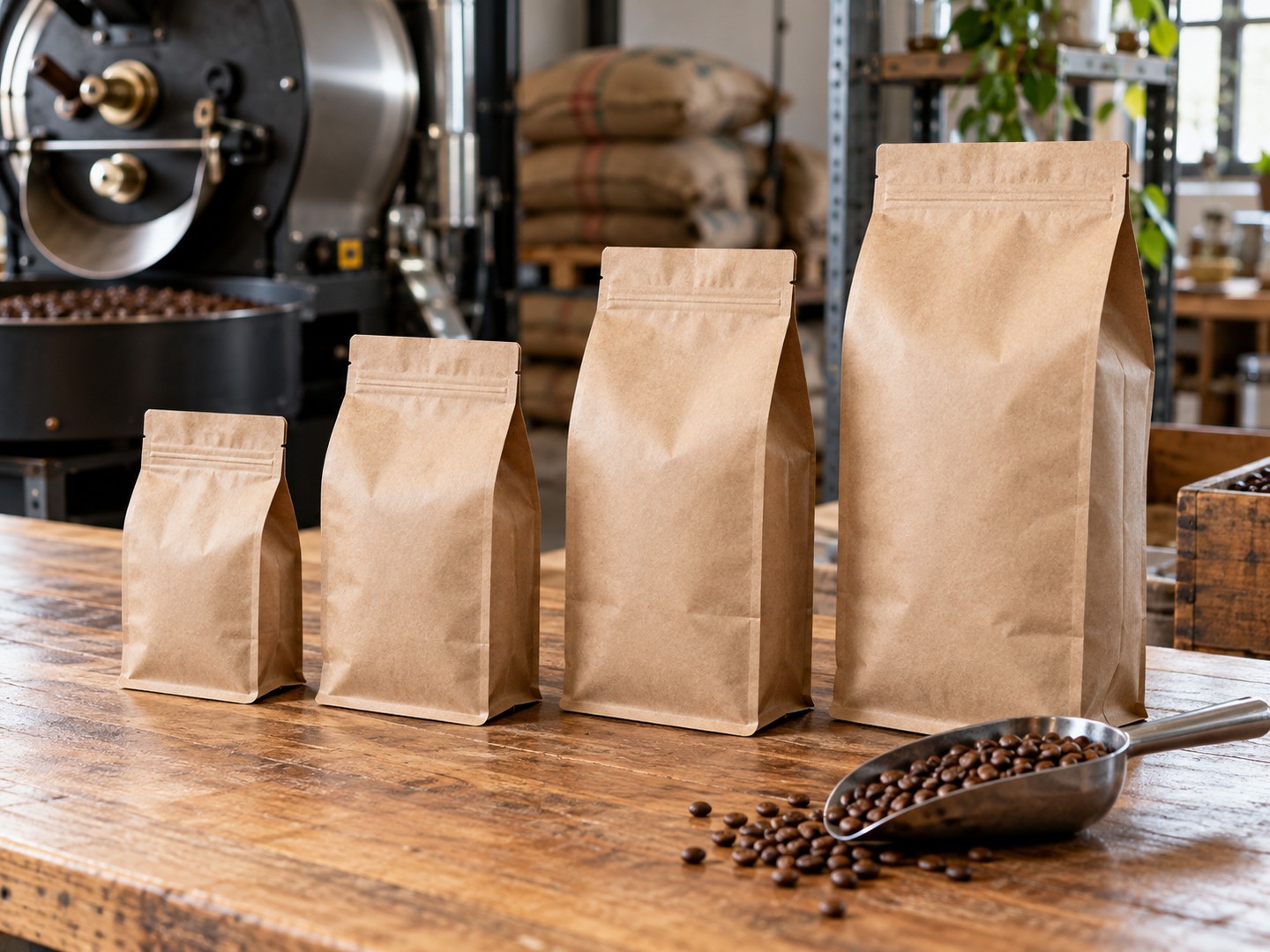
What size coffee bag do I need for 12 oz of beans?
A 12 oz (340 g) whole-bean order needs a bag of roughly 4.3″ × 9″ × 2.8″ (110 × 230 × 70 mm), about 150–180 gsm of film. Beans are lighter and bulkier than ground coffee, so always size for whole bean even if you also sell ground.
What is the difference between VMPET and aluminum foil coffee bags?
Aluminum foil (AL) blocks essentially 100% of oxygen and light; metallized PET (VMPET) blocks about 90–95%. Foil bags cost slightly more but give maximum shelf life and a full metallic finish; VMPET bags are the cost-efficient standard for most retail coffee with a 9-month-plus shelf life.
Can coffee bags be recyclable?
Yes. Mono-material PE or PP coffee bags (with recyclable valves and zippers) are the current recyclable standard and qualify for store drop-off programs in North America. They trade a small amount of barrier performance for recyclability — the right choice depends on your target shelf life and market’s recycling infrastructure.
What is the MOQ for custom printed coffee bags?
Our factory MOQ is 5,000 pieces per design for gravure-printed coffee bags, with free pre-production samples of your own artwork. Digital printing supports shorter pilot runs. Email [email protected] with your size and artwork for an exact quote within 24 hours.
Get a factory-direct quote. Sea Faith Plastics Packing has manufactured custom coffee packaging in China for 15+ years, exporting to North America, Europe, and Australia. Send us your bag size (or the coffee weight you need to hold) and artwork — we reply with a quote, laminate structure recommendation, and free sample arrangement within 24 working hours. Request a free quote →
Related guides: Kraft vs White Coffee Bags · Degassing Valve Explained · Coffee Bag Sizes Chart · Side Gusset Coffee Bags · Compostable Coffee Packaging · Block Bottom Bags Guide · How to Find a Reliable Coffee Bags Wholesale Supplier · Stand-Up Pouches: Types & Applications · Kraft Paper Coffee Bags
By Sarah Chen, Export Sales Manager at Sea Faith Plastics Packing. Last updated: October 2026.