Fresh produce packaging has one job beyond carrying: managing respiration. Fruits and vegetables keep breathing after harvest, so the right bag either vents CO₂ and ethylene out (vent-hole PE bags) or engineers a modified atmosphere inside (MAP films) — the choice decides whether produce arrives crisp or spoiled. This guide covers bag types by produce category, ventilation science in plain terms, and the specs buyers should demand from a packaging supplier.
Table of Contents
– The Respiration Problem (Why Packaging Design Matters)
– The 6 Produce Packaging Formats
– Ventilation: Micro-Perforation, Vent Holes & MAP
– Produce-by-Produce Recommendations
– Materials & Food Safety
– Custom Branding for Retail Programs
– FAQ
The Respiration Problem (Why Packaging Design Matters)
Harvested produce continues consuming oxygen and releasing CO₂, heat, and ethylene; packaging that traps these accelerates spoilage, while packaging that vents correctly slows it. Sealed in the wrong film, grapes mold and greens yellow in days. The packaging decision is therefore a gas-exchange decision first and a branding decision second:
- High-respiration produce (leafy greens, mushrooms, broccoli, herbs) needs aggressive venting or micro-perforation.
- Low-respiration produce (apples, grapes, citrus, peppers) tolerates semi-sealed bags and benefits from humidity retention.
- Ethylene-sensitive items (lettuce near bananas, kiwis near apples) need separation or ethylene-scavenging films.
The 6 Produce Packaging Formats
| Format | Typical Use | Key Feature |
|---|---|---|
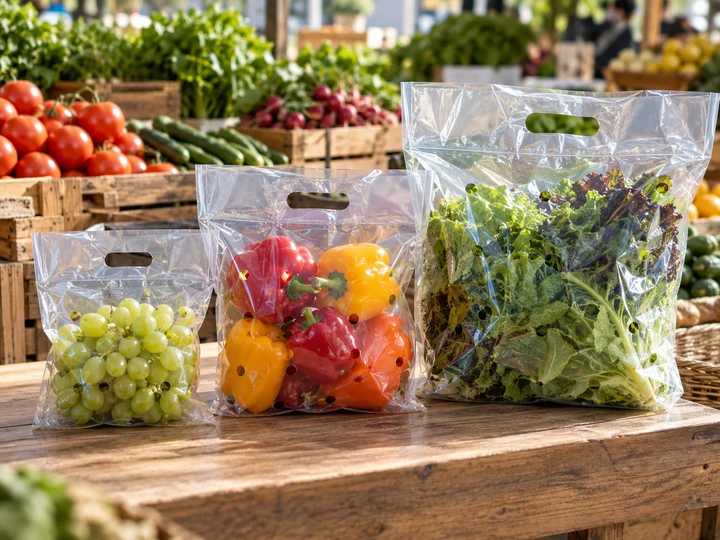
| Vent-hole PE/OPP bags | Grapes, apples, citrus, mixed produce | Die-cut or laser vent holes for gas exchange |
| PE slider stand-up bags | Berries, cherries, snack tomatoes | Resealable consumer convenience |
| Micro-perforated OPP bags | Leafy greens, mushrooms | Controlled OTR via perforation density |
| Bottom-gusset block bags | Table fruit retail display | Free-standing presentation |
| Rollstock film (FFS) | High-volume packing lines | Film rolls for automated baggers |
| Kraft/produce combos | Farmer’s market, premium organic lines | Natural look + liner |
Grape packaging is the classic engineered case: a vented PE bag sized to the display clamshell or shelf tray, often with an SO₂ generator pad inside for botrytis control. See our plastic grape bags for reference specs.
Ventilation: Micro-Perforation, Vent Holes & MAP
Three levels of gas management, in increasing sophistication:
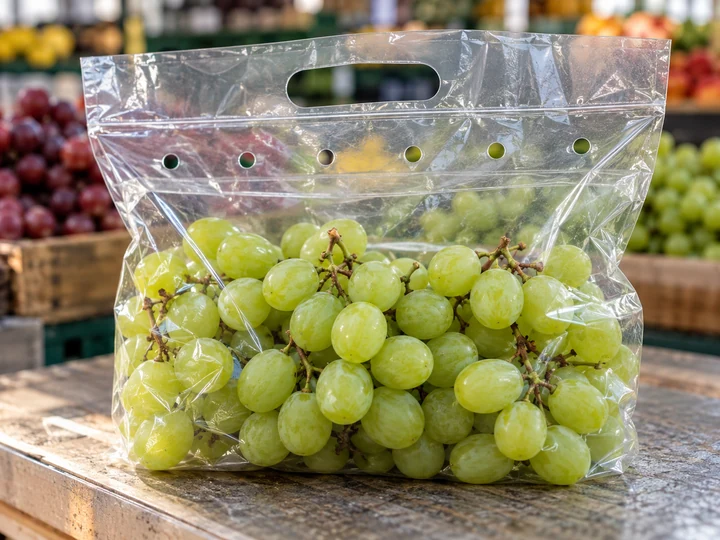
- Macro vent holes (2–6 mm): die-cut or laser-drilled holes — typically 4–16 per bag — free-exchanging gas and heat. Simple, cheap, standard for grapes, apples, and citrus.
- Micro-perforation: laser perforations of 40–200 μm; the count per m² tunes the film’s effective OTR to a specific produce’s respiration rate. This is how bagged salads survive 10+ days.
- Modified Atmosphere Packaging (MAP): engineered films where the produce’s own respiration builds a 2–5% O₂ / 3–10% CO₂ atmosphere inside the bag, slowing metabolism 2–3×. Requires matching film permeability to respiration rate at target storage temperature — a spec, not a guess.
Practical rule for packers: match perforation to coldest expected storage temperature, because respiration and film permeability both change with temperature.
Produce-by-Produce Recommendations
| Produce | Best Format | Notes |
|---|---|---|
| Table grapes | Vented PE bag + SO₂ pad | Standard vent counts; BOPP upgrade for premium |
| Apples & pears | PE/OPP vent-hole or MAP | MAP extends crispness 30–60% |
| Citrus | Mesh or vent-hole PE | High venting; shrink is the enemy |
| Berries | PE slider stand-up (retail) | Resealability drives purchase |
| Leafy greens | Micro-perforated OPP | Perforation density matched to respiration |
| Mushrooms | Micro-perforated, high humidity | Moisture balance critical |
| Cherry tomatoes | Block-bottom vented bags | Display stability |
| Bell peppers | MAP or LDPE | Low respiration; humidity retention |
| Fresh herbs | Micro-perforated + kraft sleeve | Premium retail look |
Materials & Food Safety
Fresh produce packaging is dominated by polyolefins — LDPE, LLDPE, OPP/BOPP, CPP — all food-contact safe under FDA 21 CFR 177.1520 and EU 10/2011.
- LDPE/LLDPE: the workhorse for vented produce bags; soft, clear, cheap, cold-tolerant.
- OPP/BOPP: stiffer, clearer, printable; used for micro-perforated salad bags and premium retail.
- CPP: sealant layer in laminates.
- Anti-fog additives: essential for leafy greens and berries — prevents condensation fogging that hides the product and breeds bacteria.
Thickness runs 0.035–0.08 mm for most retail produce bags. All films are recyclable mono-material PE/PP where facilities exist — a growing listing requirement at major grocers.
Custom Branding for Retail Programs
Produce is brandable — the top retail programs print: variety names, PLU/GTIN barcodes, origin stories, recipes and QR codes, and sustainability claims. Custom options at our factory:
- Up to 9-color gravure printing on PE/OPP vented bags and slider pouches
- Custom die-cut shapes and vent patterns
- Variable-size programs for seasonal fruit (grape, cherry, stone fruit)
- MOQ 5,000 pcs per design; samples free before mass production
See our stand up pouches guide for the resealable formats used in snack-fruit retail.
FAQ: Fruit & Vegetable Packaging
Why do fruit packaging bags have holes?
Vent holes let oxygen in and CO2, ethylene, and heat out, slowing spoilage for high-respiration produce like grapes, apples, and citrus. Without venting, trapped respiration gases and condensation accelerate mold and yellowing within days.
What is modified atmosphere packaging for produce?
MAP uses an engineered film whose permeability matches the produce’s respiration rate, so the produce builds its own low-oxygen, elevated-CO2 atmosphere inside the sealed bag. This slows metabolism 2-3x and can extend shelf life from days to weeks for greens and fresh-cut produce.
What material is best for vegetable packaging bags?
LDPE/LLDPE for vented bags (soft, clear, cold-tolerant), OPP/BOPP for micro-perforated salad and premium retail bags, both food-safe under FDA 21 CFR 177.1520 and EU 10/2011, with anti-fog additives for high-humidity produce.
How are grapes packaged commercially?
Table grapes ship in vented PE bags – typically 4-16 die-cut vents – with an SO2 generator pad inside for botrytis control, sized to retail trays. Premium programs upgrade to printed BOPP with custom vent patterns.
Can produce bags be branded?
Yes. Gravure printing handles up to 9 colors on PE/OPP bags at 10,000-piece MOQ – variety names, barcodes, origin stories, recipes and QR codes, which is how bagged-fruit programs build shelf differentiation.
Are produce packaging bags recyclable?
PE and PP produce films are mono-material and recyclable where film collection exists (store drop-off in North America). Anti-fog additives and printing inks are formulated to stay within recyclability guidelines.
Supplying a retail produce program? Sea Faith Plastics Packing manufactures vented PE bags, micro-perforated OPP film, and resealable slider pouches for fruit and vegetables — custom printed at factory MOQ. Send your produce type and bag size for samples: Request a quote →
Related guides: Stand Up Pouches Guide · Kraft Paper Bags Guide
By Sarah Chen, Export Sales Manager at Sea Faith Plastics Packing. Last updated: October 2026.