Kraft paper bags give brands the natural, artisanal look consumers read as “organic and trustworthy” — and when laminated correctly, they protect food as well as any plastic pouch. The key is understanding that a modern kraft bag is a composite: paper outside, functional film layers inside. This guide covers kraft paper types, laminate structures, every common bag style, and how to order custom kraft packaging at factory MOQ.
Table of Contents
– Brown vs. White Kraft: What You’re Actually Buying
– [Why Kraft Bags Are Laminated (Structures)]#structures)
– The 6 Kraft Bag Styles That Dominate Retail
– Windows, Zippers & Tin-Ties: Feature Options
– Food Safety & Certifications
– Cost & MOQ: What Custom Kraft Bags Really Cost
– Are Kraft Bags Actually Eco-Friendly?
– FAQ
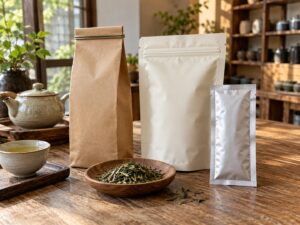
Brown vs. White Kraft: What You’re Actually Buying
Kraft paper is produced by the kraft (sulfate) pulping process; unbleached stock is the familiar brown, bleached stock is white. For packaging buyers the differences that matter:
| Brown kraft | White kraft | |
|---|---|---|
| Look | Natural, rustic, “organic” | Clean, premium, print-friendly |
| Print contrast | Dark base limits light inks | Full-color printing pops |
| Food association | Bakery, coffee, farm produce | Specialty coffee, tea, supplements |
| Cost | Slightly lower | Slightly higher |
| Recyclability story | Same (with the caveats below) | Same |
Weight options run from 40 gsm (inner liners) to 60–120 gsm (outer bag layers). Heavier paper improves stiffness and shelf presence but adds cost — most stand-up kraft pouches use 40–60 gsm outer paper.
Why Kraft Bags Are Laminated (Structures)
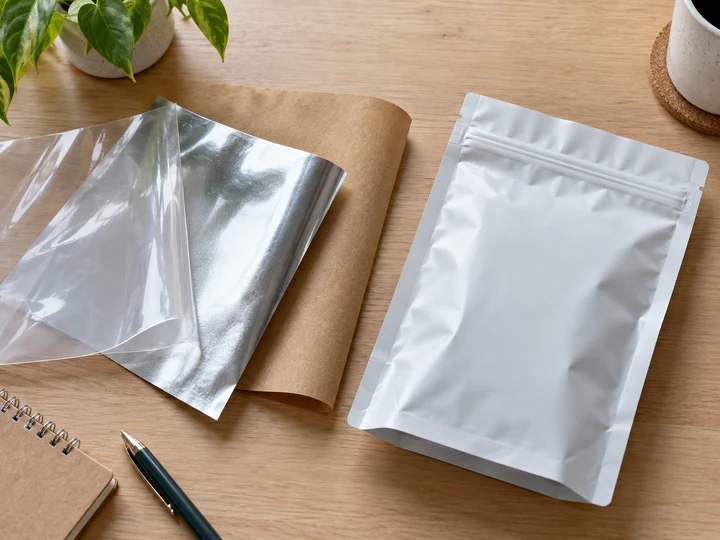
Pure paper cannot block oxygen, moisture, or grease — every food-grade kraft bag is a laminate with paper as the outer skin. The functional layers decide shelf life:
| Structure | Protection Level | Typical Use |
|---|---|---|
| Kraft/PE | Moisture only | Bakery, dry goods, short shelf life |
| Kraft/PET/VMPET/PE | Oxygen + light + moisture (metallized) | Coffee, tea, nuts, snacks |
| Kraft/PET/AL/PE | Maximum barrier (foil) | Coffee (long shelf life), powders |
| Kraft/Paper/PLA (compostable line) | Moderate | Certified compostable programs |
The metallized and foil versions are why a “paper bag” can hold roasted coffee for 9–12 months — the paper never touches the barrier job; the inner laminate does.
The 6 Kraft Bag Styles That Dominate Retail
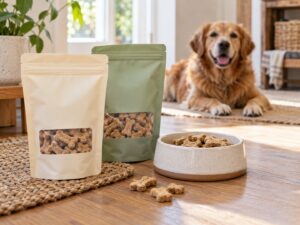
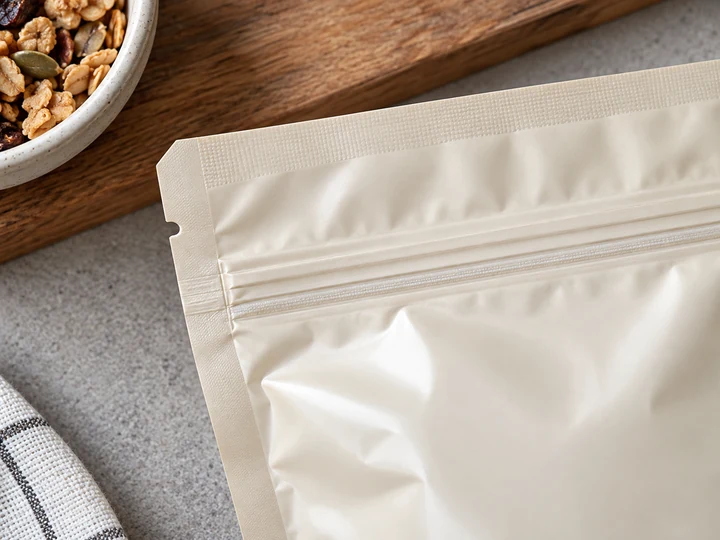
- Kraft stand-up pouches — the volume leader. Bottom gusset, zipper, optional valve and window; used for coffee, nuts, granola, pet treats. See product examples: white kraft stand-up zipper coffee bag.
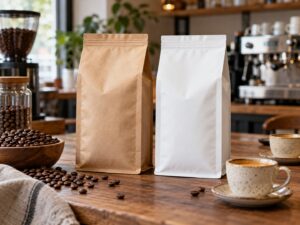
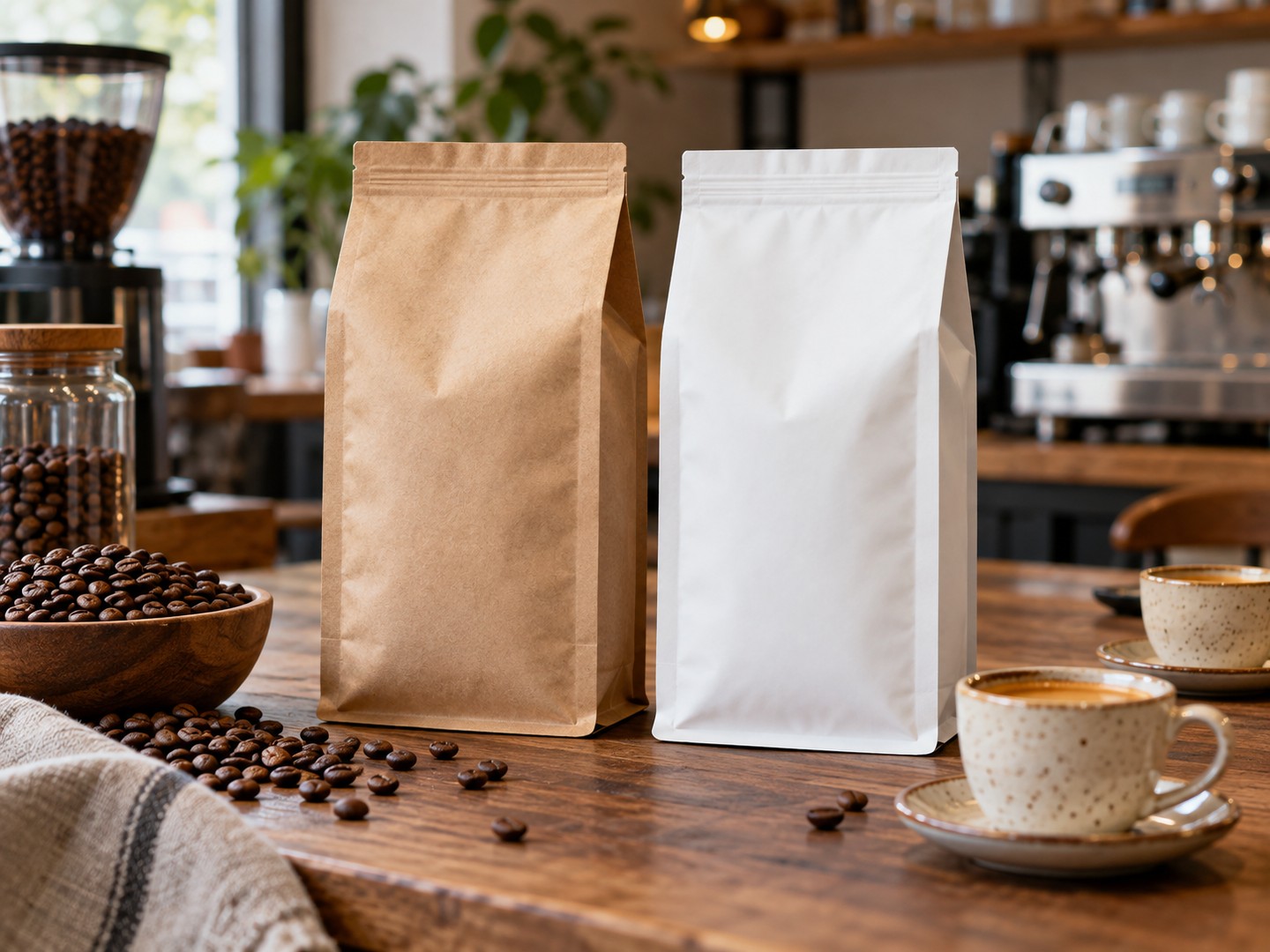
- Kraft flat bottom bags — box-bottom stability for premium coffee and specialty food; large base panel for branding.
- Kraft side gusset bags — the traditional coffee format in kraft; folds flat, ships economically.
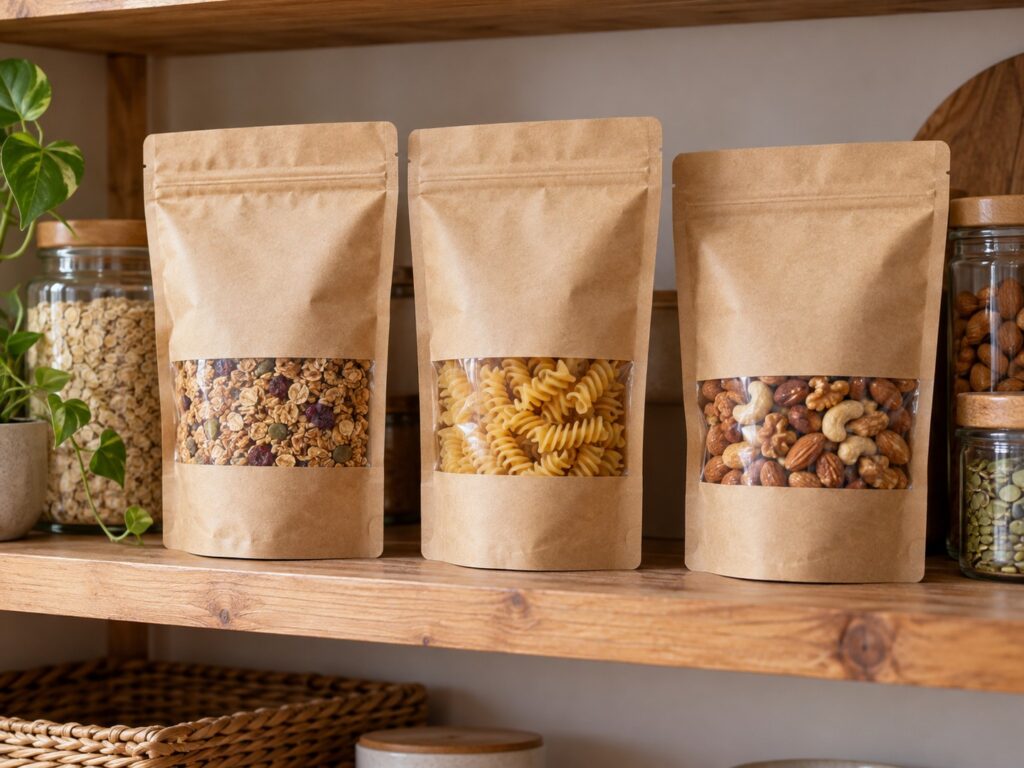
- Kraft window bags — die-cut or full-panel window (PET or PLA film) to show product; standard for bakery, granola, dried fruit. Example: oval window kraft stand-up bag.
- Kraft tin-tie bags — counter bags for cafés and refill shops; bend-to-close metal tie inside the top fold.
- Kraft SOS paper bags (no laminate) — the classic grocery/bakery take-away bag; food-contact safe for dry goods, not a barrier package.
Windows, Zippers & Tin-Ties: Feature Options
- Windows: PET (clear, food-safe, recyclable-separated) or PLA (compostable lines). Oval and square die-cuts are standard shapes; full-face windows maximize product display.
- Zippers: press-close or slide zippers laminated between layers; kraft bags with zippers dominate the 100 g–1 kg resealable snack and coffee segment.
- One-way degassing valves: essential for roasted coffee; mounted center-back. See coffee packaging guide for valve details.
- Tin-ties: bendable metal closure in the top fold for counter service.
- Tear notches & hang holes: for display pegs and easy open.
Food Safety & Certifications
The kraft layer itself is food-contact safe when unbleached and food-grade; in laminates, the inner PE or CPP sealant layer is the actual food-contact surface and must comply with FDA 21 CFR 177.1520 (US) or EU 10/2011 (EU). Request:
- Food-contact compliance certificates for the sealant layer
- FSC certification for the kraft paper if you market sustainable sourcing
- Documented grease resistance (KIT rating) for oily products like nuts
Cost & MOQ: What Custom Kraft Bags Really Cost
Custom printed kraft stand-up pouches typically run $0.05–0.15 per piece at 10,000-piece MOQ, depending on size, structure, and window/valve options — comparable to full-plastic pouches, because the paper layer replaces (not adds to) the printed outer film. Cost drivers, in order of impact:
- Barrier layer choice (PE < VMPET < AL)
- Window die-cutting (adds a converting step)
- Bag size (film + paper consumption)
- Finish (matte/kraft-natural adds little; soft-touch adds more)
Our MOQ is 5,000 pcs per design with free pre-production samples; production takes 15–20 days after artwork approval.
Are Kraft Bags Actually Eco-Friendly?
The honest answer: the paper layer is renewable and recyclable-friendly, but the laminate (and especially the window and zipper) determines the real end-of-life. Positioning guidance for brands:
- Kraft + PE laminates: recyclable in some paper-stream programs where plastic content is low; otherwise store drop-off as film.
- Kraft with mono-PE inner structure: the strongest recyclability story among laminated kraft bags.
- Certified compostable kraft (PLA-lined): credible only with EN 13432 / BPI certification printed on the bag.
- Beware “plastic-free” claims on laminated kraft — regulators and consumers increasingly check.
If recyclability is central to your brand, also review our recyclable spout pouch guide for mono-material design principles that apply to kraft laminates.
FAQ: Kraft Paper Bags
Are kraft paper bags food safe?
Yes, when built as a laminate: the kraft paper is food-grade and the inner PE/CPP sealant layer that touches food complies with FDA 21 CFR 177.1520 or EU 10/2011. Pure unlined kraft is safe for dry, short-shelf-life goods like bakery takeaway.
Can kraft paper bags hold coffee long term?
Yes — kraft/PET/AL/PE or kraft/PET/VMPET/PE laminates with a one-way degassing valve keep roasted coffee fresh 9–12 months. The kraft layer provides the look; the inner laminate provides the oxygen and light barrier.
What is the difference between brown and white kraft bags?
Bleaching. Brown kraft is unbleached (natural look, slightly lower cost); white kraft is bleached for a clean surface that makes full-color printing pop. Barrier performance is identical once laminated.
Are kraft bags recyclable?
The paper layer is, but the laminate decides the outcome. Kraft + mono-PE structures are the most recyclable; foil-lined and heavily plastic-laminated kraft typically ends in store drop-off streams. Compostable kraft (PLA-lined) is credible only with EN 13432 or BPI certification.
What is the MOQ for custom kraft paper bags?
Our factory MOQ is 5,000 pieces per design including custom printing, windows, zippers, and valves. Free pre-production samples of your artwork are provided; production takes 15–20 days after approval.
How much do custom kraft stand up pouches cost?
$0.05–0.15 per piece at 10,000-piece volume depending on size, barrier layer, and options like windows and valves — price-competitive with full-plastic pouches since the paper replaces the printed outer film.
Ordering kraft packaging? Sea Faith Plastics Packing manufactures custom kraft paper bags — stand-up, flat bottom, window, zipper, valve — at factory MOQ with free samples. Send your size and artwork for a quote within 24 hours: Request a quote → · Popular products: clear-window resealable kraft bags · kraft flat bottom coffee bags
Related guides: Tea Packaging Guide · Tin-Tie Coffee Bags · Coffee Packaging: Types & Materials · Stand-Up Pouches Guide
By Sarah Chen, Export Sales Manager at Sea Faith Plastics Packing. Last updated: October 2026.