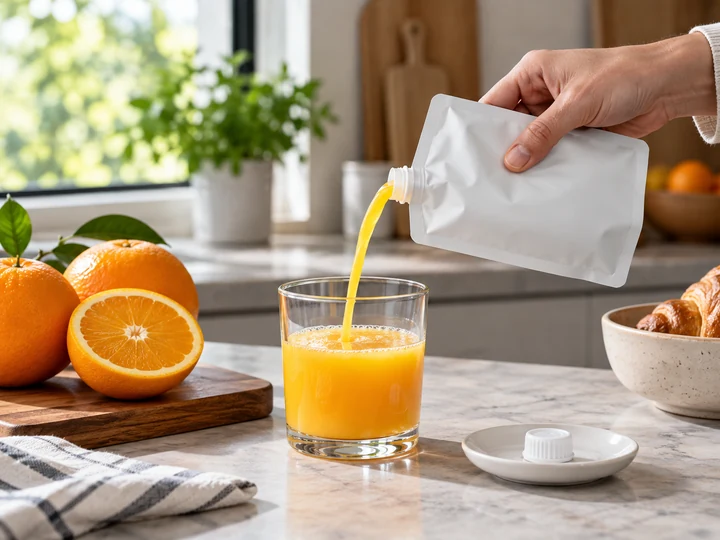
A spout pouch is a flexible stand-up bag fitted with a welded spout and screw cap, built from multilayer laminate to hold liquids and semi-liquids safely. It replaces rigid bottles at a fraction of the weight and shipping cost — that’s why juice, baby food, detergent, wine, and sauce brands have switched in the last decade. This guide covers pouch structures, spout and cap options, filling methods, and the exact specifications buyers should put in a first inquiry.
Table of Contents
– What Is a Spout Pouch?
– Why Brands Switch From Bottles
– Anatomy: Film Structure & Spout/Cap Options
– Applications by Industry
– Spout Pouch vs. Bottles vs. Cartons (Comparison)
– How Spout Pouches Are Filled
– How to Specify Your First Order (Buyer’s Checklist)
– FAQ
What Is a Spout Pouch?
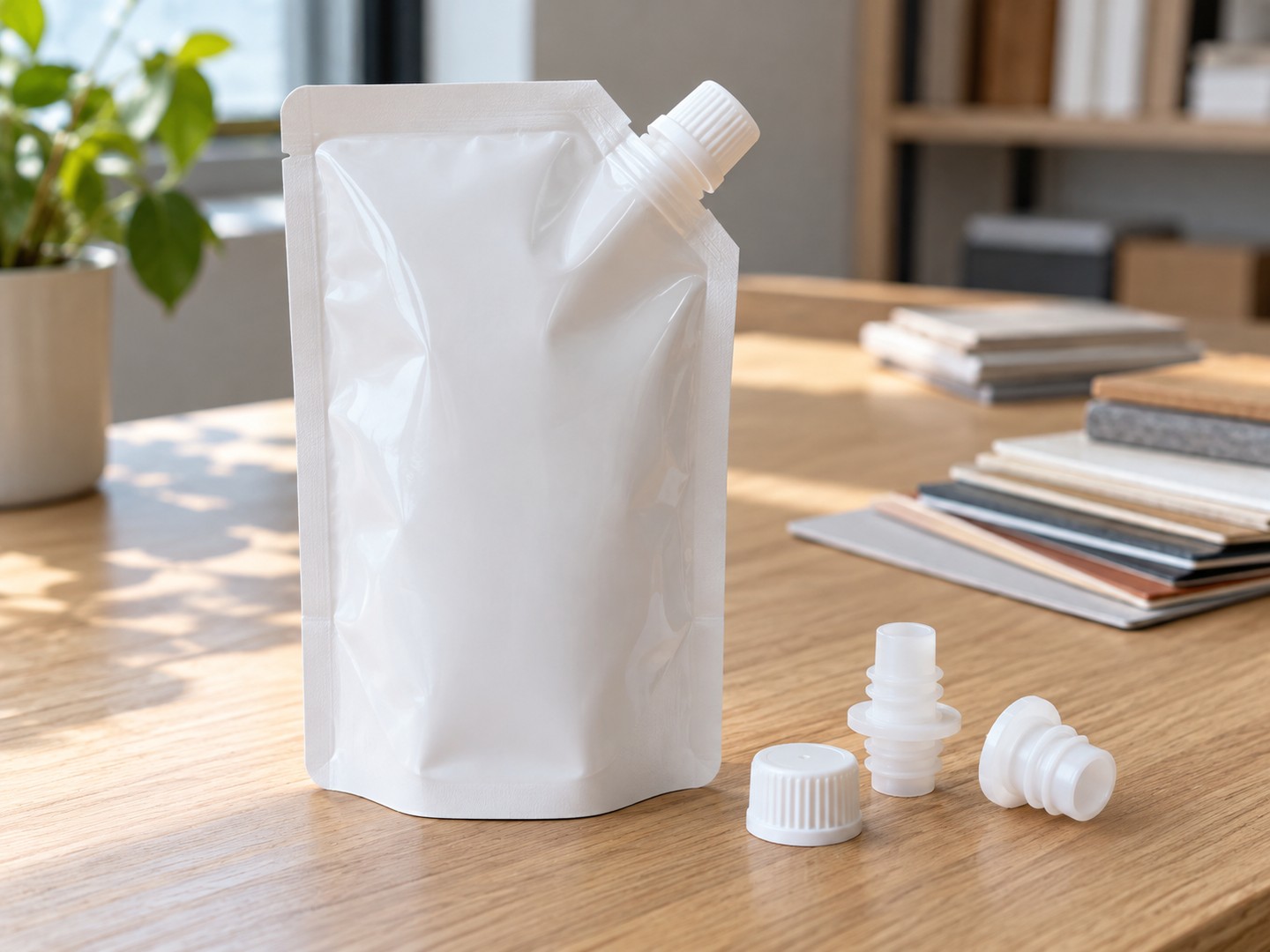
A spout pouch (also called a spouted pouch or spout bag) is a flexible laminated pouch with a threaded spout heat-welded into the film, sealed by a screw cap. The pouch body typically stands up on a bottom gusset, holds anywhere from 50 ml to 10 L, and pours or squeezes cleanly through the spout without funnels or scissors. Standard constructions use 3–4 laminate layers with a total thickness of 100–180 μm; food-grade structures comply with FDA and EU 10/2011 food-contact requirements.
Two facts define the format for buyers: weight (an empty 300 ml spout pouch weighs about 6–8 g versus 30–45 g for a PET bottle), and freight (pouches ship flat, so one 40 ft container carries several times more filled-equivalent units than bottles — filled pouches still cut packaged volume dramatically).
Why Brands Switch From Bottles
- Cost: packaging material cost per unit is typically 30–60% lower than rigid bottles of the same volume, and inbound freight for empty packaging falls by 70–85% because pouches ship flat.
- Shelf impact: full-body edge-to-edge printing on a standing pouch out-displays a label-wrapped bottle.
- Convenience: resealable screw caps, straws for kids, and one-handed squeezing fit modern consumption — especially baby food, sports drinks, and on-the-go sauces.
- Sustainability: less plastic per unit; recyclable mono-material spout pouches are now mainstream (see our recyclable spout pouch guide).
- Dosing & safety: child-resistant caps and tamper-evident seals are available for chemicals and pharma-adjacent products.
Anatomy: Film Structure & Spout/Cap Options

Film structures by product type
| Product | Recommended Structure | Why |
|---|---|---|
| Juice, flavored drinks (hot-fill) | PET/AL/PE or PET/NY/PE | Oxygen barrier + puncture resistance; retort-capable versions add NY |
| Baby food (retort) | PET/AL/NY/PE (retort grade) | Withstands 121°C retort sterilization |
| Detergent, liquids (household) | PET/VMPET/PE | Barrier + chemical resistance |
| Wine, cocktails (shelf-stable) | PET/AL/PE + outer gloss | Maximum oxygen barrier for 12-month shelf life |
| Sauces, paste (retort or aseptic) | PET/AL/NY/PE | Heat + barrier + drop strength |
| Eco lines | Recyclable PE/PE mono-material | Store drop-off recyclability |
Spout and cap options
- Spout diameter: 8.6 mm (std), 12 mm (viscous), 15–18 mm (thick sauces, refills)
- Spout position: top-center (classic), corner (Angel-style pour), or side
- Cap: standard screw cap, flip-top cap, child-resistant cap, tamper-evident cap, sport nozzle
- Extras: straw hole die-cut, hang hole, laser score for easy tear
Sizes
Common stock sizes: 100 ml, 200 ml, 250 ml, 300 ml, 350 ml, 400 ml, 500 ml, 1 L, 2 L, 3 L, 5 L, and 10 L refill pouches. Custom dimensions and shapes are made to order at MOQ.
Applications by Industry
- Beverage: juice, coconut water, cold brew, cocktails-to-go — see our dedicated juice pouch guide
- Baby & toddler food: retort-grade purées with choke-free spouts
- Household chemicals: laundry liquid refills, detergents, floor cleaner (up to 3–5 L)
- Alcohol: wine and RTD cocktails in 187 ml–3 L (the famous “wine pouch” format)
- Food service: sauce, syrup, broth and soup refills in 1–10 L — including nozzle-tip formats like our dispenser tip pouch
- Personal care: shampoo, body wash refill pouches
Spout Pouch vs. Bottles vs. Cartons
| Spout Pouch | PET Bottle | Carton | |
|---|---|---|---|
| Empty packaging weight (300 ml) | 6–8 g | 30–45 g | 28–40 g |
| Empty freight volume | Ships flat (≈85% saving) | Rigid | Rigid |
| Unit packaging cost | Low | Medium | Medium |
| Resealable | Screw cap | Screw cap | Rarely |
| Shelf printing area | 100% body | Label only | Partial |
| Shelf life (juice, chilled→ambient) | 9–12 mo (foil) | 6–9 mo | 6–9 mo |
| Recycling | Mono-PE versions recyclable | Widely recyclable | Widely recyclable |
How Spout Pouches Are Filled
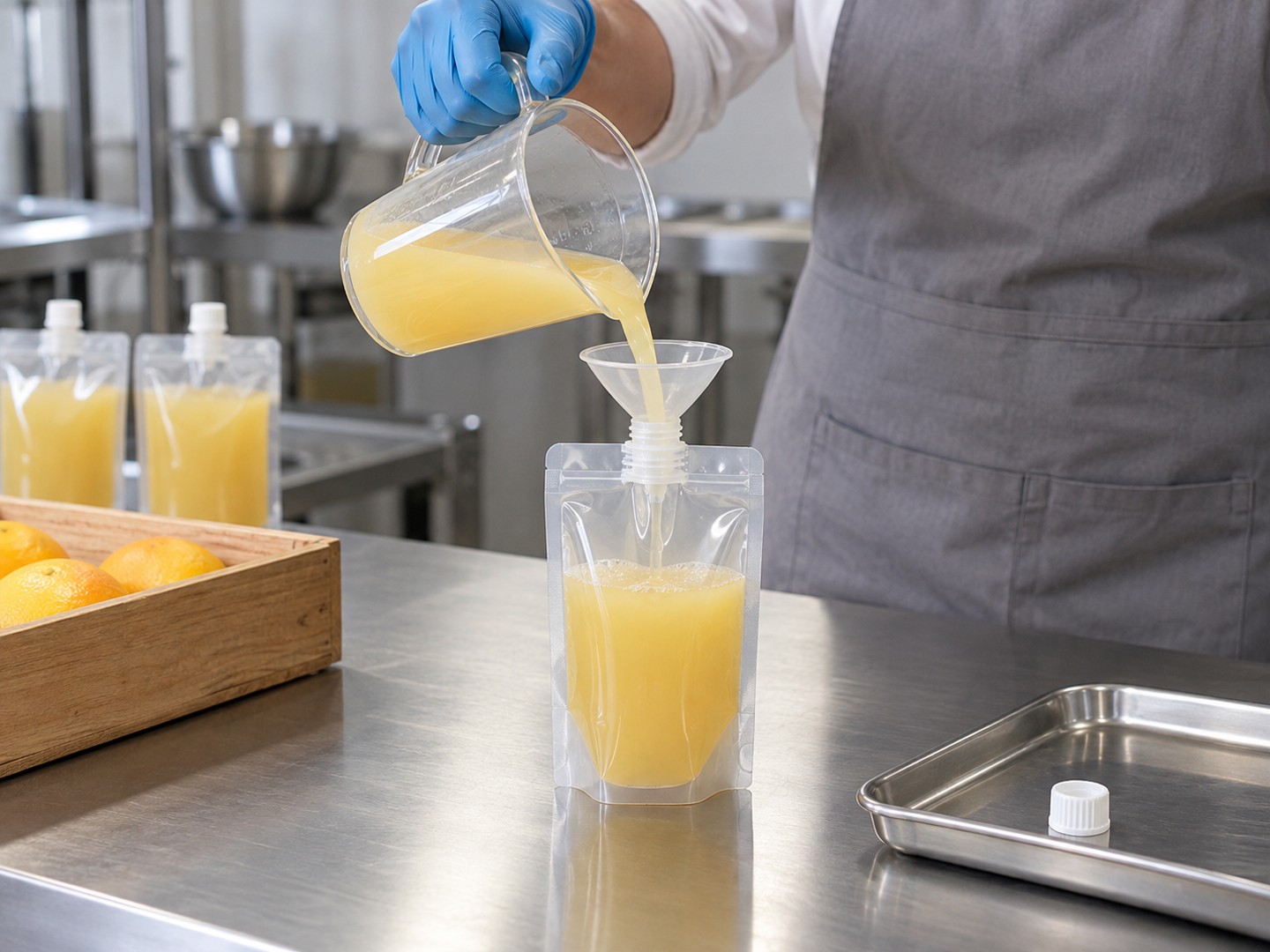
- Manual / semi-auto (startups): pouches are filled through the open spout with a tabletop filler and hand-capped. Output: 300–800 pouches/hour. Lowest entry cost, standard for first production runs.
- Automatic rotary filling lines: pouches are fed, spout-opening, vacuum-filled, nitrogen-flushed (for juice and wine), and capped at 2,000–12,000 pouches/hour. Requires pouches made to the line’s spout diameter and pouch-profile spec — tell your filling machine brand when ordering.
- Hot-fill and retort: for shelf-stable juice and baby food, pouches must be made with retort-grade laminate (PET/AL/NY/PE) and high-temperature adhesive — confirm this before ordering, or seals will fail in the sterilizer.
Lead-time tip: spouts and caps are customized to cap color and orifice, so confirm spout spec at artwork stage, not after printing.
How to Specify Your First Order (Buyer’s Checklist)
Put these eight specs in your first inquiry and any serious factory can quote within 24 hours:
- Fill volume and product (viscosity, hot-fill/retort/ambient)
- Pouch size or “suggest size for X ml” — good factories propose dimensions
- Structure preference: foil (max shelf life), VMPET (cost balance), or recyclable mono-PE
- Spout diameter, position, and cap type/color
- Printing: artwork file, number of colors, matte/gloss
- Quantity per design
- Filling method (manual, rotary machine brand if known)
- Destination market (determines food-contact standard: FDA or EU)
Our standard MOQ is 5,000 pcs per design, with free pre-production samples of your artwork. Typical timeline: 15–20 days production + sea freight.
FAQ: Spout Pouch Packaging
What is a spout pouch used for?
Spout pouches package liquids and semi-liquids: juice, baby food purées, wine, detergents, sauces, shampoos, and industrial refills from 50 ml to 10 L. The welded spout and screw cap allow clean pouring, squeezing, and resealing without tools.
What material is a spout pouch made of?
A standard spout pouch is a 3–4 layer laminate: PET (print layer), AL foil or VMPET (oxygen/light barrier), NY (puncture resistance for retort), and PE or CPP (food-contact seal layer), totaling 100–180 μm. Retort pouches for baby food use PET/AL/NY/PE to survive 121°C sterilization.
How much does spout pouch packaging cost compared to bottles?
Empty pouches cost 30–60% less per unit than equivalent rigid bottles, and because they ship flat, inbound freight for packaging drops by 70–85%. Overall, switching from bottles to pouches commonly cuts total packaging and transport cost by around half at scale.
Can spout pouches be recycled?
Yes — mono-material PE/PE spout pouches with compatible spouts qualify for store drop-off recycling in North America. The trade-off is slightly lower barrier than foil structures. Hybrid “design-for-recycling” lines now cover most juice and detergent applications.
What is the MOQ for custom spout pouches?
Our factory MOQ is 5,000 pieces per design, including your printing, choice of spout, and cap color. Free pre-production samples with your artwork are provided before mass production; lead time is 15–20 days after approval.
Can spout pouches handle hot filling or retort?
Yes, if specified at ordering: retort-grade structures (PET/AL/NY/PE with high-temperature adhesive and retort spouts) survive 121°C sterilization for baby food and sauces, and hot-fill structures handle 85–95°C filling for juice. Standard ambient pouches will fail at those temperatures.
Ready to spec your pouch? Send us your fill volume, product, and artwork — Sea Faith Plastics Packing engineers will propose the structure, spout, and size, with free samples. 15+ years exporting spout pouches to beverage, household, and food-service brands. Request a quote → — or see our FDA foil spouted stand-up pouch and 5 L corner-spout pouch product pages.
Related guides: Retort Pouches Guide · Spout Pouch vs Bottles · How to Fill Spout Pouches · Juice Pouch Bags: Complete Guide · Recyclable Spout Pouches · What Is a Dispenser Tip Pouch?
By Sarah Chen, Export Sales Manager at Sea Faith Plastics Packing. Last updated: October 2026.