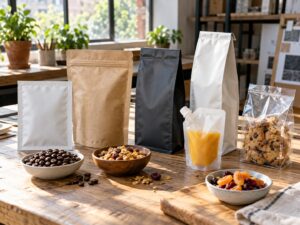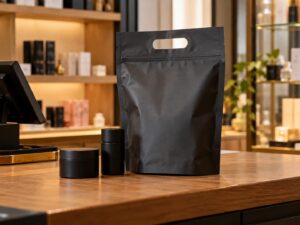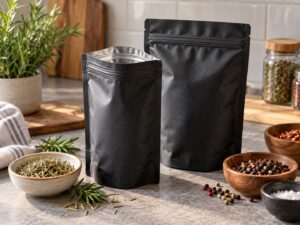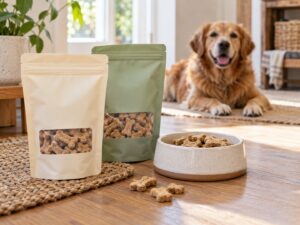
Child resistant (CR) packaging is packaging engineered to be significantly difficult for children under five to open — while remaining usable for adults — and it is legally required for cannabis, pharmaceuticals, and an expanding list of household chemicals across North America. For brands in regulated categories, CR compliance is not a feature; it is the license to sell. This guide covers how CR packaging works, which regulations apply, how certification testing happens, and how to source CR bags that pass inspection the first time.
Table of Contents
– What Exactly Is Child-Resistant Packaging?
– How CR Closures Work
– The Regulations: PPRA, CPSC & ASTM D3475
– Industries That Require CR Packaging
– CR Packaging Formats Compared
– How CR Certification Testing Works
– Sourcing Checklist: Ordering Custom CR Bags
– FAQ
What Exactly Is Child-Resistant Packaging?
Child-resistant packaging requires a dual action — or a coordinated level of dexterity and strength — that most children under five cannot perform, but most adults can. The standard definition comes from the US Poison Prevention Packaging Act (PPPA) of 1970: the package must significantly deter children from opening it within a reasonable testing period, while not being difficult for normal adults.
Two critical distinctions buyers often miss:
- “Child resistant” ≠ “child proof.” CR packaging slows children down and defeats casual access; testing standards accept that a percentage of children may eventually open it (the thresholds are defined in the protocol).
- Senior-friendly matters too. Certified CR packaging must remain openable by a majority of adults aged 50–70 — the dual mandate that makes good CR design genuinely engineering, not just a harder zipper.
How CR Closures Work
Flexible CR pouches (the dominant cannabis and pharma-adjacent format) rely on clever mechanics in the zipper or seal:
| Mechanism | How It Works | Typical Products |
|---|---|---|
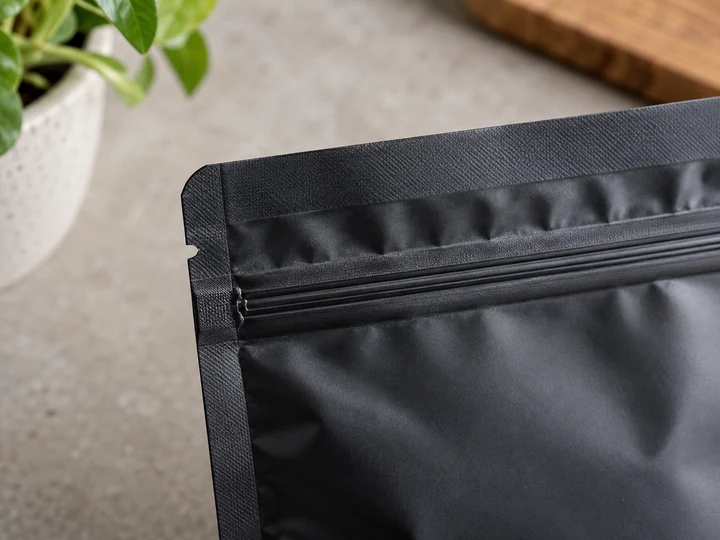
| Press & zip (Pinch & Pull) | Two panels must be pressed together while pulling the zipper from a marked tab | Cannabis flower, edibles |
| Squeeze & slide | Squeeze the bag sides to release a sliding lock bar | Pre-rolls, gummies |
| Hidden pull-tab | Interior tab must be located and pulled through a slot before opening | Pharma, OTC |
| Certified locking zipper | Proprietary slider with spring-loaded lock (e.g., certified lock zippers) | High-value flower, extracts |
| CR spout cap | Push-turn or squeeze-turn cap on liquid pouches | Liquid pharmaceuticals, chemicals |
For rigid formats the classics are push-turn caps (bottles) and blister packs with peel-push foil. The flexible-pouch versions above deliver equivalent certification at a fraction of the cost per unit.
The Regulations: PPRA, CPSC & ASTM D3475
In the US, the Poison Prevention Packaging Act (administered by the CPSC) defines when CR packaging is mandatory and how it is tested; ASTM D3475 is the standard classification catalog for child-resistant packages. Layer in state-level cannabis rules and the picture is:
- Federal PPPA/PPRA: requires CR packaging for aspirin, OTC painkillers, dietary supplements containing iron, and ~30 drug/household categories.
- CPSC 16 CFR 1700.20: the actual test protocol — package tested with panels of 50% children aged 42–51 months (max 200 children, 80% must fail to open within 10 minutes including a demo) and 100 adults aged 50–70 (90% must be able to open and re-close).
- ASTM D3475: the classification standard listing recognized CR package types; state cannabis regulators cite it in packaging rules.
- State cannabis regulations: nearly every legal state requires CR packaging for cannabis products; most reference ASTM D3475 or CPSC protocol compliance, and several require re-sealable CR packs for multi-serve products.
For brands, the practical takeaway: your package must be certified, and your state’s cannabis rules may add labeling and opacity requirements on top.
Industries That Require CR Packaging
- Cannabis: flower, pre-rolls, edibles, concentrates, vapes — all 50+ legal markets require CR
- Pharmaceutical & OTC: prescription drugs and listed OTC products under PPPA
- Dietary supplements: iron-containing and certain other formats
- Household chemicals: laundry pods, drain cleaners, pesticides
- E-liquids & nicotine: federal Child Nicotine Poisoning Prevention Act requires CR for all vaping liquids
- Emerging: THC beverages, hemp-derived delta products, and some states’ rules for kratom
CR Packaging Formats Compared
| Format | Resealable | Typical Sizes | MOQ* | Best For |
|---|---|---|---|---|
| CR zip pouch (press & zip) | ✅ | 1 g – 1 oz | 10,000 | Flower, edibles |
| CR exit bag (dispensary) | ✅ | Small–XL | 10,000 | Dispensary checkout |
| CR mylar bag (certified slider) | ✅ | 1/8 oz – 1 lb | 10,000 | Premium flower |
| CR rigid tube/vial | ✅ | Single pre-roll | varies | Pre-rolls |
| CR blister | ❌ | Single dose | varies | Pharma |
| CR spout pouch | ✅ | 100 ml–1 L | 10,000 | Liquids, chemicals |
*Our factory MOQ is 5,000 pcs per design; certification documents and CR-mechanism samples are provided before mass production.
How CR Certification Testing Works
A CR package earns certification by passing the CPSC 16 CFR 1700.20 protocol with independent, accredited labs — not by the factory declaring it. The process brands should expect:
- Supplier’s CR mechanism design is tested by an accredited lab (child/adult panels per protocol).
- Lab issues a certification report naming the package configuration.
- Any change to film thickness, zipper supplier, or bag size requires re-certification — ask whether the certificate covers YOUR exact configuration.
- Batch consistency: the mechanism must be identical in production, which is why you should buy from the factory that makes the certified configuration, not a re-seller.
Red flag: suppliers offering “CR bags” with no lab report, or a report for a different bag size than you’re ordering.
Sourcing Checklist: Ordering Custom CR Bags
- Ask for the certification report first — confirm it matches the size/mechanism you’re buying.
- Specify the mechanism: press & zip vs. squeeze & slide vs. locking slider — each has different senior-friendliness and cost.
- Barrier spec: for cannabis, pair the CR zipper with foil or VMPET barrier for smell-proofing and terpene retention (see our marijuana child-resistant bags deep-dive).
- Opacity rules: many states require opaque or child-appeal-restricted designs — no cartoons, no bright candy colors where prohibited.
- Custom printing: full-color printing is available at CR MOQ; matte finishes and spot UV are popular in the category.
- Test samples personally: have five adults open and re-close each sample ten times — mechanism failure in the field is a recall, not a refund.
FAQ: Child Resistant Packaging
What is child-resistant packaging and how does it work?
Child-resistant packaging uses a dual-action opening mechanism — press-and-zip, squeeze-and-slide, or push-turn — that children under five cannot easily coordinate but adults can. Certification requires passing CPSC 16 CFR 1700.20 panel testing: at least 80% of tested children must fail to open it, while 90% of adults aged 50-70 must succeed.
What are the child-resistant packaging requirements in the US?
The Poison Prevention Packaging Act (PPPA) mandates CR packaging for prescription drugs and about 30 OTC/household categories, tested under CPSC 16 CFR 1700.20. State cannabis laws additionally require certified CR packaging for all cannabis products, most citing ASTM D3475 classifications, and the Child Nicotine Poisoning Prevention Act requires CR for e-liquids.
What is the best child-resistant packaging for cannabis?
For flower and edibles, certified press-and-zip mylar pouches with foil or VMPET barrier are the market standard — resealable, smell-proof, customizable, and passable at state inspection. Multi-serve products need resealable CR packs in most states; single-serve pre-rolls often use CR tubes.
Are child-resistant bags reusable?
Yes — quality CR zip pouches are designed for repeated opening and closing. The certification protocol specifically tests re-closability (90% of adult panelists must re-close correctly), and most mechanisms are rated for hundreds of open/close cycles in normal use.
Is there recyclable child-resistant packaging?
Mono-material PE CR pouches are now available, pairing recyclable film with the certified CR zipper. Barrier performance is lower than foil structures, so they suit products with shorter shelf-life requirements. Ask for APR Design Guide compatibility statements when sourcing.
What is the MOQ for custom CR bags?
Our factory MOQ is 5,000 pieces per design including custom printing, with the CR certification documentation provided for the exact configuration. Pre-production samples let you test the mechanism before committing; lead time is 15–20 days.
Sourcing CR packaging for a regulated product? Sea Faith Plastics Packing manufactures certified child-resistant pouches with full lab documentation, custom printing, and factory-direct MOQ. Send your product type and quantity for a quote with certification papers: Request a quote → · See product examples: CR pouch with zipper · CR stand-up packaging · smell-proof CR pouch
Related guide: Marijuana & Child-Resistant Bags: Deep Dive · CBD Packaging Bags Guide
By Sarah Chen, Export Sales Manager at Sea Faith Plastics Packing. Last updated: October 2026.